
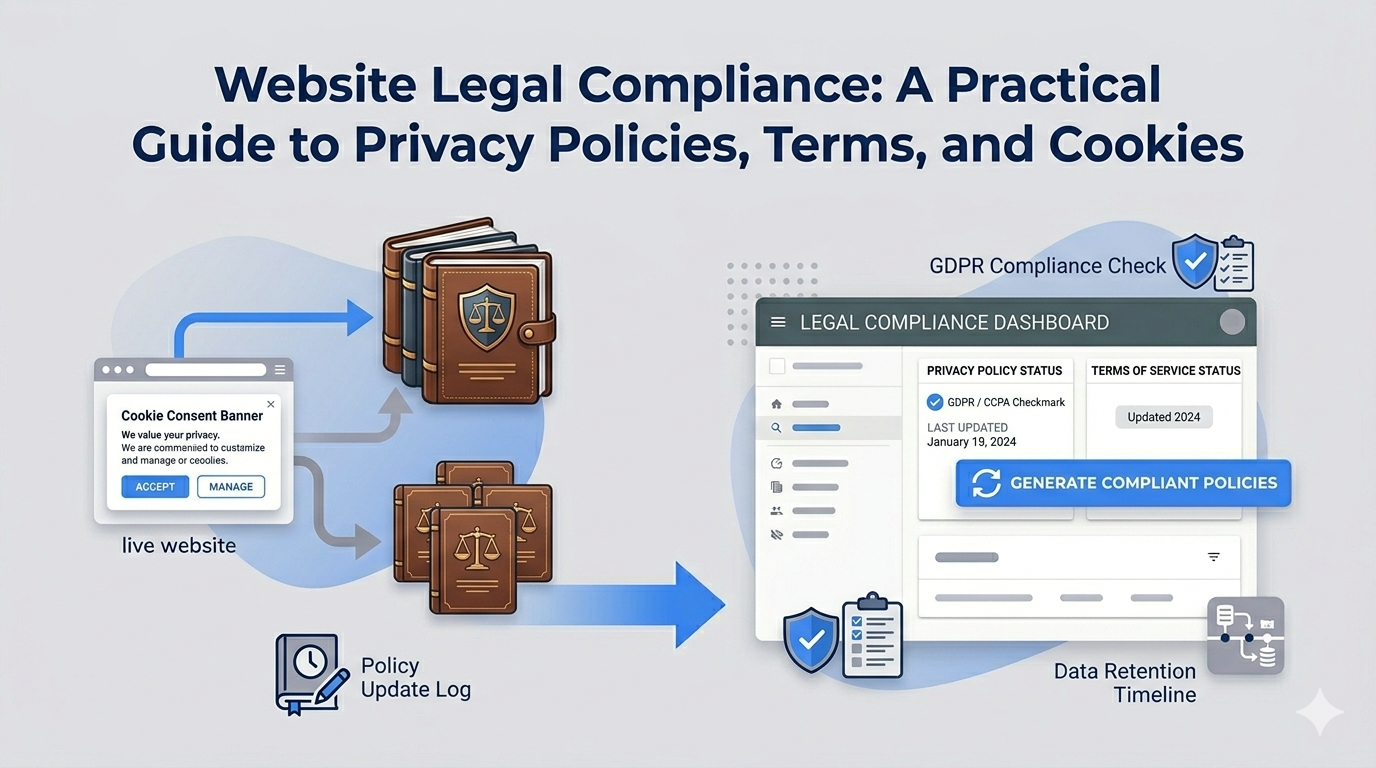
Website Legal Compliance: A Practical Guide to Privacy Policies, Terms, and Cookies
Launching a website is easier than ever. Staying legally compliant is not.
Many early-stage site owners focus on design, content, and traffic—but overlook the legal foundations that quietly shape user trust and protect the business behind the site. Privacy policies, terms of service, and cookie disclosures aren’t just formalities. They’re expectations. In some regions, they’re legal requirements.

The good news: you don’t need to be a lawyer to get the basics right. You do need to understand what each document does, why it matters, and how to implement it in a way that’s clear, honest, and aligned with how your website actually operates.
Why Website Compliance Matters More Than You Think
Legal pages often get treated as checkbox items—something you add at the end. That’s risky.
A properly set up compliance structure helps you:
- Build credibility with users who are increasingly privacy-aware
- Avoid unnecessary legal exposure
- Clarify how your site operates, collects data, and handles disputes
More importantly, it forces you to think through how your website works behind the scenes. If your policies don’t match reality, that mismatch becomes your liability.
The Three Core Pieces Every Website Needs
At a minimum, most websites should include:
- A Privacy Policy (how you collect and use data)
- Terms and Conditions (rules for using your site)
- A Cookie Policy or Notice (how tracking technologies are used)
Each serves a different purpose. Skipping or copying them blindly creates gaps that are easy to overlook until they matter.
Privacy Policy: What You Collect and Why
A privacy policy explains what personal data you collect and how you use it. If your website has:
- Contact forms
- Analytics tools
- Email subscriptions
- User accounts
- Payment processing
—you are collecting data, even if it feels minimal.
What to Include
A clear privacy policy typically covers:
- What data you collect (names, emails, IP addresses, etc.)
- How you collect it (forms, cookies, third-party tools)
- Why you collect it (communication, analytics, transactions)
- How you store and protect it
- Who you share it with (if anyone, including service providers)
- User rights (access, deletion, opt-out where applicable)
Clarity matters more than length. Avoid vague statements. If you use tools like analytics platforms or email marketing services, say so.
Where to Place It
Your privacy policy should be easy to find:
- Footer of every page
- Linked during form submissions
- Referenced in signup flows
If users have to hunt for it, you’ve already lost part of the trust equation.
Terms and Conditions: Setting the Rules
Terms and Conditions (also called Terms of Service) define how people are allowed to use your website—and what happens if something goes wrong.
This is where you protect your content, limit liability, and set boundaries.
What to Include
Your terms don’t need to be overly complex, but they should address:
- Acceptable use (what users can and cannot do)
- Intellectual property (ownership of your content)
- Disclaimers (accuracy, availability, or professional advice limits)
- Limitation of liability
- Termination rights (when you can restrict access)
- Governing law (which jurisdiction applies)
If your site includes user-generated content, comments, or transactions, your terms become even more important.
Why It’s Often Overlooked
Unlike privacy policies, terms aren’t always legally required—but they’re strategically essential.
Without them, you have less control if disputes arise.
Cookies: The Quiet Tracker You Can’t Ignore
Cookies are small files stored on a user’s device that help your website function and gather insights.
If your site uses:
- Analytics tools
- Ad platforms
- Embedded content (videos, maps, social feeds)
—you’re almost certainly using cookies.
What Users Expect
At a minimum, users expect transparency. In many regions, they also expect:
- A clear explanation of cookie usage
- The ability to accept or reject non-essential cookies
Cookie Notice vs Cookie Policy
- A cookie notice is the banner users see when they first visit
- A cookie policy explains details in depth
For simple websites, a combined approach often works: a banner with a link to a detailed explanation.
How to Add These to Your Website (Without Overcomplicating It)
You don’t need a complex setup to get started. A practical approach works best.
Step 1: Audit Your Website
Before writing anything, understand your own setup:
- What data are you collecting?
- Which third-party tools are installed?
- Are you storing user information?
This step prevents generic policies that don’t match reality.
Step 2: Create Tailored Documents
Avoid copying random templates without editing them.
Start with a reliable base, then customize:
- Replace placeholders
- Remove irrelevant sections
- Add specific tools and practices you actually use
Precision matters more than legal jargon.
Step 3: Publish and Link Clearly
Add links to:
- Website footer
- Checkout or signup pages
- Contact forms
Consistency builds credibility.
Step 4: Add a Cookie Consent Banner
If your site uses cookies beyond basic functionality, implement a banner that:
- Appears on first visit
- Explains usage briefly
- Links to your policy
Plenty of lightweight tools can handle this without slowing down your site.
Common Mistakes That Undermine Compliance
Even well-meaning site owners make avoidable mistakes.
Copy-Paste Policies That Don’t Match Reality
Using a template without editing it can create contradictions. For example:
- Saying you don’t share data when you use third-party tools
- Listing features your site doesn’t even have
If challenged, those inconsistencies matter.
Hiding Legal Pages
Burying links or making them hard to access signals that you’re not taking them seriously.
Ignoring Updates
Your policies should evolve with your website. Adding a new tool or feature without updating your policy creates gaps.
Assuming “Small Site = No Risk”
Even small sites collect data. Even small sites build audiences. Compliance isn’t about size—it’s about responsibility.
When You Should Consider Professional Help
For many simple websites, a well-informed DIY approach is enough.
But you should consider legal input if:
- You handle sensitive data
- You operate across multiple countries
- You run a membership platform or marketplace
- You process payments directly
At that stage, generic documents stop being enough.
A Practical Mindset for Staying Compliant
Think of compliance as part of your user experience—not a separate legal layer.
Good policies:
- Reflect how your site actually works
- Are written in plain, readable language
- Respect user awareness and control
You’re not trying to impress lawyers. You’re trying to be clear with real people.
Final Thoughts
Website legal compliance doesn’t have to be overwhelming, but it does require intention.
A clear privacy policy, thoughtful terms, and transparent cookie handling create a foundation that supports both trust and growth. They show users you understand your responsibilities—and take them seriously.
Set it up carefully once, revisit it as your site evolves, and you’ll avoid the scramble that comes from fixing it too late.